Warrington guides
Resin and Epoxy Flooring Guides for Warrington Units
Read the guides below to understand what a resin floor involves before you ask for a price. Sending an enquiry costs nothing and takes a minute.
Preparing concrete before any coating goes down
A resin floor fails or holds depending on what happens before the first tin is opened. The concrete underneath has to be sound, dry and profiled so the coating can grip it.
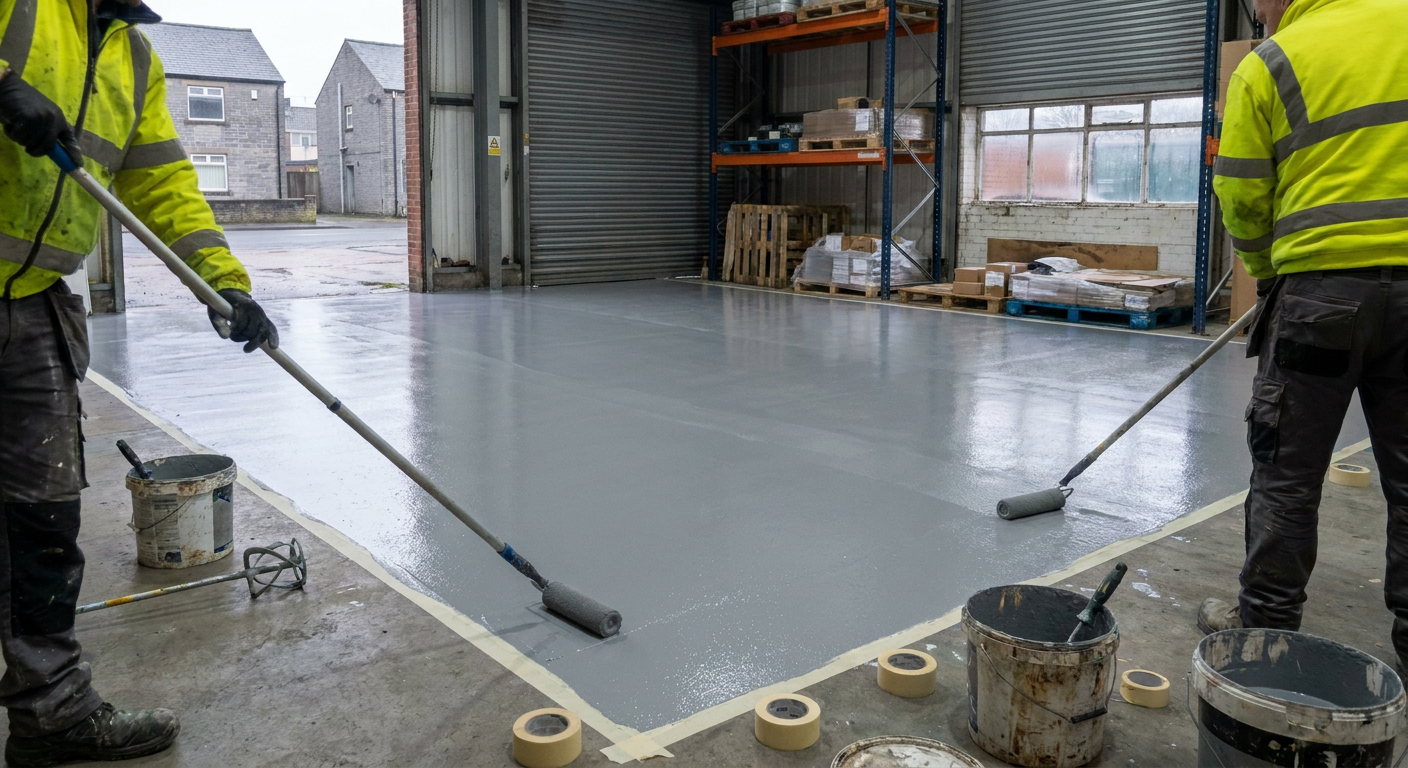
Grinding opens the pores of old slabs and removes laitance from new ones. If moisture is present, the specialist tests the slab and decides whether a damp proof membrane is needed before any resin goes down. Skipping this step causes blisters and peeling later.
The thickness of the system matters too. A 2mm roller-applied coat suits light foot traffic, while a 4mm trowelled screed handles pallet trucks and heavy racking. Choosing the wrong one means paying twice.
Find out more about preparing a concrete floor for resin, dealing with damp concrete under epoxy, choosing the right resin floor thickness, and understanding what drives the cost per square metre in Warrington.
Choosing the right coating for the space
A food factory floor faces hot wash-downs and bacterial growth, so the coating applied there must meet hygiene standards. A cold store needs a resin that cures at low temperatures without turning brittle.
Workshops and MOT bays deal with oil, brake fluid and dropped tools. The resin specified for those spaces requires chemical resistance and enough thickness to absorb impact. Garages carry lighter loads but still need a finish that resists tyre pickup and road salt.
Showrooms and retail spaces use clear or lightly pigmented finishes where appearance matters alongside wear resistance. Car park decks require waterproofing and UV stability because they sit exposed to weather and constant vehicle movement.
Read what each space demands: [epoxy resin flooring options](/coatings/epoxy-resin-flooring-warrington), [garage floor coatings](/coatings/garage-floor-coating-warrington), [warehouse floor painting](/coatings/warehouse-floor-painting-warrington), [workshop and MOT bay floors](/coatings/workshop-and-mot-bay-floors), [food factory coatings](/coatings/food-and-drink-factory-floors), [cold store systems](/coatings/cold-store-and-chiller-floors), [showroom finishes](/coatings/showroom-and-retail-resin-floors), [car park deck coatings](/coatings/car-park-deck-coating) and [anti slip floor coatings for wet areas](/coatings/anti-slip-floor-coating-warrington).
Joints, lines and keeping the floor safe
Concrete moves. It shrinks as it cures and expands with temperature changes. If a resin floor bridges an expansion joint without addressing it, the coating will crack along that line. The specialist cuts or honours existing joints so the floor can move without tearing itself apart.
Line marking turns an open warehouse slab into a working layout. Bays, walkways and loading zones get painted in colours that contrast with the main floor. This keeps forklifts away from pedestrian routes and makes stock locations obvious.
Slip resistance is another variable the specialist controls. Aggregate broadcast into the wet resin gives grip in areas where water, oil or dust collect. Anti static formulations are available for spaces handling sensitive electronics, preventing charge build-up that damages components.
Read more about handling expansion joints in resin floors, warehouse floor line marking layouts, anti static resin flooring for ESD environments, and choosing resin floor colours for bays and walkways.
Living with a resin floor once it is down
Curing time dictates when the space can be used again. Foot traffic might be allowed after twelve hours, but pallet trucks usually need several days. The specialist plans the pour around the building schedule so downtime stays short.
Ventilation during installation matters, particularly in enclosed units. Epoxy releases fumes while it cures, and the specialist manages airflow to keep the workspace safe for everyone nearby.
When damage does happen, patching is possible. Small cracks or worn patches get ground back and filled with matching resin rather than replacing the whole floor. Loading bays take the most punishment, so thresholds and dock edges sometimes need attention first.
Mezzanine floors and steel decks also accept resin coatings, though the preparation differs from concrete because the substrate flexes under load.
Find out how long before you can walk on a resin floor, why epoxy floors flake and how to repair them, managing epoxy smell and fumes during works, coating mezzanine floors and steel decks, repairing resin floors, and protecting loading bay docks and ramps.
Areas covered around Warrington
The specialists who carry out this work operate across Warrington and the surrounding WA postcodes. Units in Newton le Willows, Earlestown and Burtonwood see the same preparation and coating methods as those closer to the town centre.
Garage coatings are common in Lymm, Great Sankey and Penketh, where homeowners want something tougher than bare concrete. Warehouses in Birchwood, Norton and Dallam typically need heavier systems built for daily forklift traffic and racking loads.
Each area guide covers the typical buildings found there and the coatings suited to them. Reading the one closest to your location gives a clearer picture of what the specialist will suggest when they visit.
Check the guides for resin flooring in Newton le Willows, Earlestown, Burtonwood, Birchwood, Norton and Dallam. For garages, read the pages covering Lymm, Great Sankey and Penketh. The full list of postcode areas is also available.
Ask about your floor in Warrington
Send a few details about your space and what you need. The enquiry goes to a specialist firm who will reply with advice or a price. There is no obligation to proceed.
- No obligation to proceed
- Free to send an enquiry
- Local firms respond