
Warrington cold stores
Cold store floor coating for chillers and freezers
Describe the space and the temperatures involved. A specialist firm will assess the slab and provide a price for the work without any obligation to proceed.
Why freezer floors need different resin
A standard warehouse floor fails in a chiller because the chemistry of normal epoxy requires warmth to cure. In units across Omega and Birchwood, cold store floor coating uses resins formulated to set at sub-zero temperatures. This low temperature epoxy flooring remains workable even when the slab is well below freezing.
The other problem is thermal shock. When a forklift drives from an ambient loading bay into a minus-twenty freezer, the surface expands and contracts rapidly. A finish that cannot flex with those movements will crack within weeks. Specialist firms apply a thermal shock floor coating designed to absorb this stress without losing adhesion to the concrete beneath.
Moisture compounds the difficulty. Cold slabs attract condensation the moment warm air touches them. The contractor must account for this by preparing the surface correctly, sometimes using moisture-tolerant primers before the main resin goes down. Read more about how damp affects adhesion on the page about [damp concrete and resin](/before-the-pour/damp-concrete-and-resin).
Working inside a live cold store
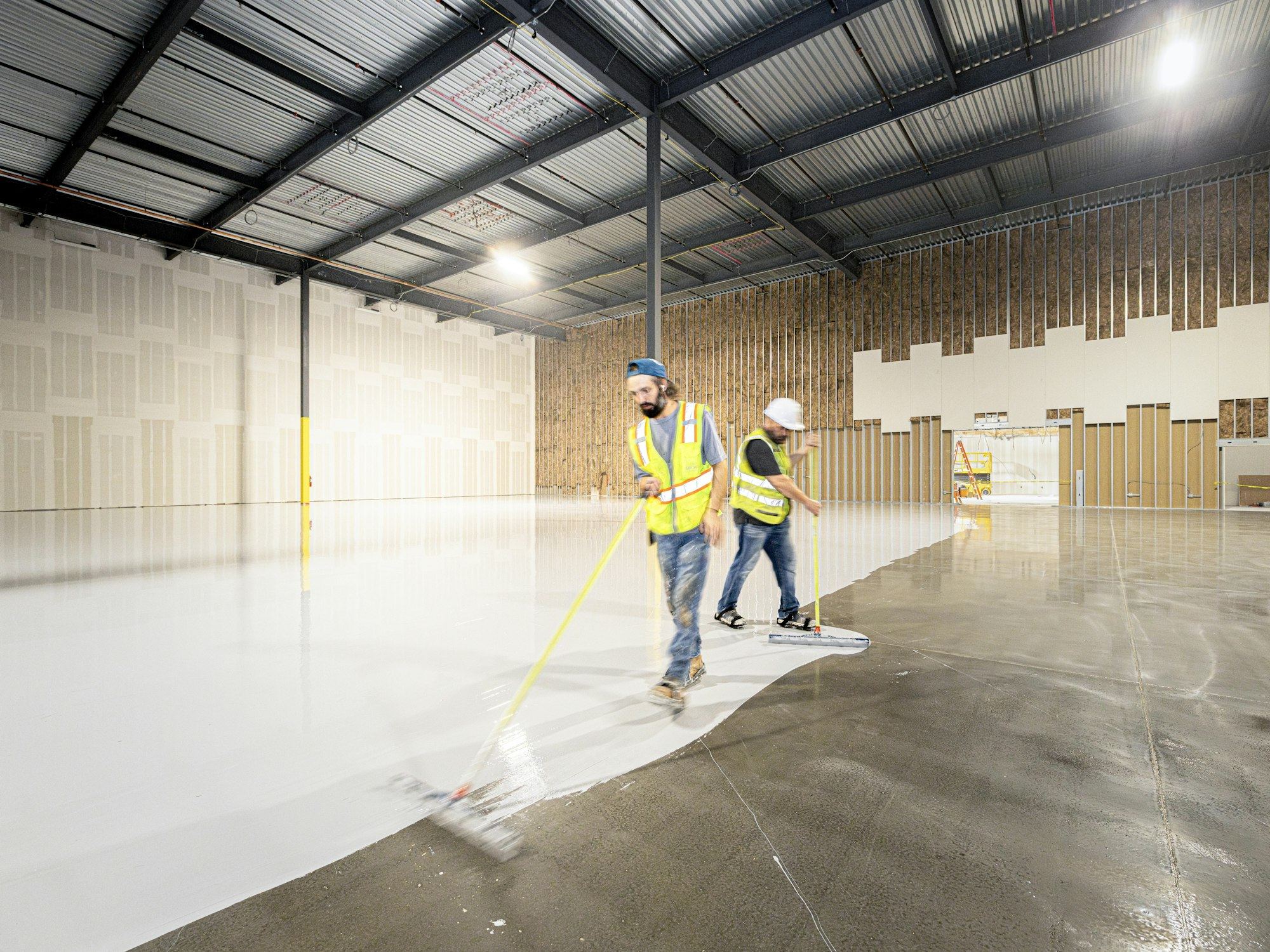
Shutting down a chiller to let a floor cure costs money every hour it sits empty. Many cold store flooring contractors use fast-curing methyl methacrylate or modified epoxy systems that harden while the refrigeration plant keeps running. This means a unit on the Omega estate does not need to be switched off and allowed to warm up before work starts.
The resin still needs preparation. The specialist firm will grind or shot-blast the concrete to open the pores, even in the cold. Dust extraction matters more here because ventilation is limited when doors stay shut to hold the temperature. Find out what that preparation involves on the page about [preparing a concrete floor](/before-the-pour/preparing-a-concrete-floor).
Cure times are short. Some freezer floor resin systems in Warrington reach full hardness in under two hours, so a shift can resume quickly. The exact time depends on the product chosen and the actual slab temperature at the point of application.
Targeted repairs instead of full coverage
Not every job requires coating the entire room. Often the damage concentrates where pallet trucks pivot at the door line or where ice builds up near the evaporators. A specialist firm can limit the work to the loading dock and the chiller threshold rather than resurfacing the whole store.
Blast freezer floor repair follows the same principles but demands faster turnaround because production schedules in food plants leave almost no downtime. The contractor cuts out the failed section, primes the exposed concrete and fills it with a resin matched to the surrounding thickness. More detail on partial fixes is available on the [resin floor repairs](/coatings/resin-floor-repairs-warrington) page.
Chiller room floor paint applied only to high-traffic zones saves material and time. It also reduces the amount of solvent vapour released into a confined cold space, which matters for staff working nearby during the application.
Cost and specification differences
Expect the price per square metre to sit higher than a standard warehouse floor. The raw materials cost more because they contain accelerators and flexible polymers that standard epoxy lacks. Labour rates reflect the uncomfortable working environment and the shorter windows available between shifts.
Thickness plays a part too. A heavily trafficked freezer bay might need four millimetres or more to survive steel wheels and dropped pallets. Thinner films suit walk-in chillers with lighter foot traffic. The page on [resin floor thickness](/before-the-pour/resin-floor-thickness-warrington) explains how depth affects durability.
For context on general pricing in the area, the guide to [resin floor cost](/before-the-pour/resin-floor-cost) breaks down what sets the price in Warrington. A cold environment adds a premium, but the alternative is replacing a failed coating twice a year. Getting the specification right first avoids that cycle.
Signs your cold store floor is failing
Cold store floors fail because the slab contracts in deep cold and expands when warm air enters from loading docks. This constant movement cracks standard coatings and lifts edges. A cold store floor coating uses low-temperature curing resins that flex with these shifts instead of breaking away.
- 1
Ridges at the door threshold
Raised edges where warm meets cold suggest the coating is lifting because of repeated expansion and contraction cycles.
- 2
White powder on the surface
Chalking indicates the resin has degraded, often from moisture trapped beneath the film during the original application.
- 3
Potholes near racking legs
Localised craters show where pallet truck wheels have broken through a weakened top layer down to bare concrete.

- 4
Peeling strips along joints
Coating pulling away from saw cuts means movement in the slab exceeds what the rigid film can tolerate.
Questions about cold store resin floors
Answers to the things site managers in Warrington ask before booking the work.
- Coating without switching off the chiller
- Yes. Specialist firms use resins that cure at operating temperature, so the plant stays on throughout the job.
- Minimum curing temperature
- Certain systems harden at minus twenty degrees Celsius. The exact limit depends on the specific resin selected for the slab conditions.
- Forklifts bringing warm air inside
- Thermal cycling causes rigid coatings to crack. Flexible formulations absorb the expansion and prevent delamination at the boundary.
- Downtime for the chilled area
- Fast-curing products allow foot traffic in one to two hours and full pallet truck use shortly after that.
- Coating just the threshold
- Partial application is standard practice. Contractors focus on docks and door lines where wear concentrates rather than doing the whole room.
- Cost compared to a warehouse floor
- Cold store resin costs more per square metre because of specialised chemistry and difficult working conditions, but lasts far longer in freezers.
Tell us about your cold store floor
Send the dimensions and current temperature. A specialist firm will review the details and reply with a method statement and price. There is no commitment to proceed.
- No obligation to buy
- Specialist assessment included
- Prices for Warrington sites